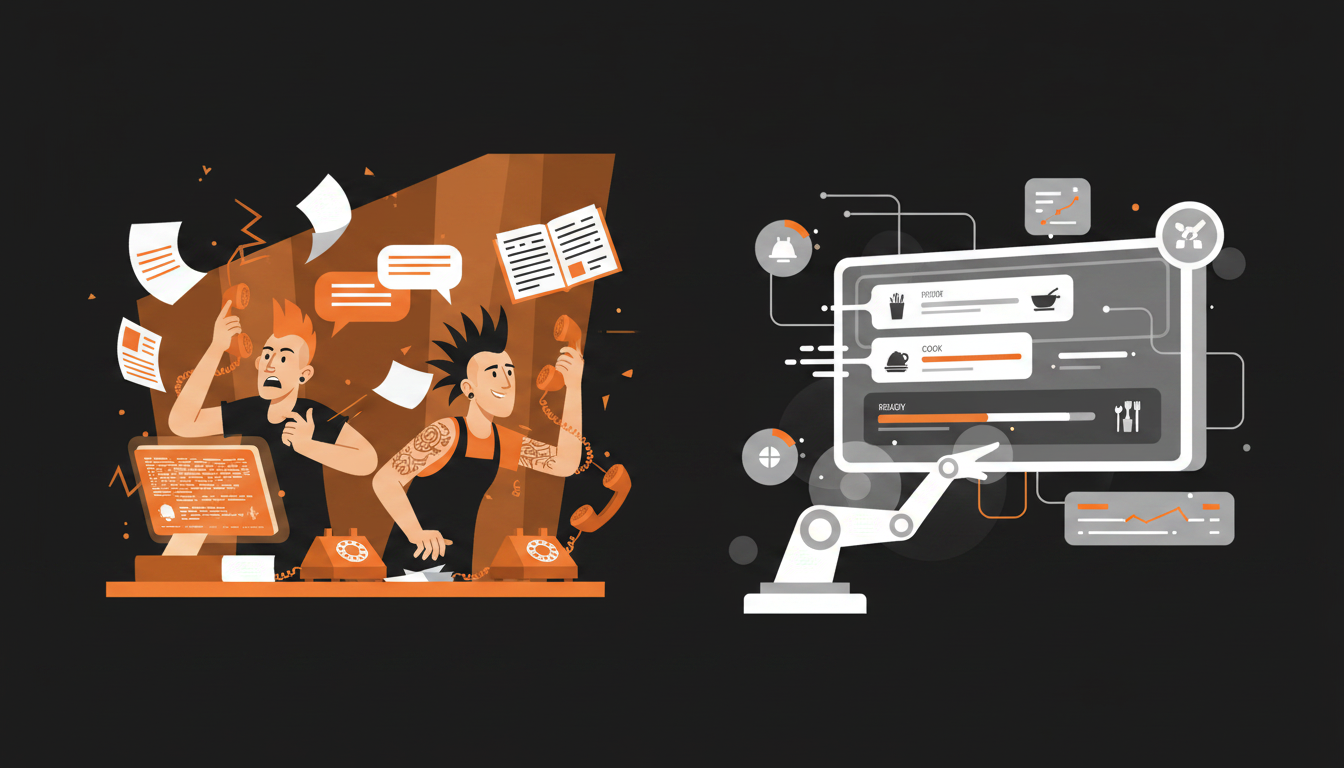
83% of customers will order from a competitor if their call goes to voicemail more than once. The average restaurant misses 10-20 calls per day during rush - and it's not a staffing problem. It's a physics problem. Your best server can't greet a table and take a phone order at the same time.
I built Claw Prime because I watched restaurants hemorrhage money every single night from calls nobody picked up. Not because the staff didn't care. Because they were slammed. And the phone just kept ringing.
Let me break down what that's actually costing you, which tools actually work, how the tech connects to your existing setup, and exactly when you'll see your money back.
What's the real cost of missed calls?
The answer is somewhere between painful and devastating, depending on your volume.
If you're missing 10-20 calls per day during rush (industry data via Biteberry), and the average phone order runs $25-$30, you're looking at $250-$500 in daily revenue walking out the door. Multiply that across a month and you're at $7,500-$15,000. Annually? $90,000-$180,000 in orders that went to your competitor down the street.
And that's conservative. It doesn't count the lifetime value of a customer who never came back because you missed their call twice. According to Biteberry's February 2026 report, the AI phone ordering market is projected to hit $49 billion by 2029. That's not hype money. That's restaurants collectively waking up to the fact that missed calls are a six-figure leak hiding in plain sight.
Here's what kills me about this stat: an AdValorem AI report from March 2026 found that 34% of restaurants are already using some form of voice AI. That means a third of your competitors are picking up every single call, and you're still sending people to voicemail.
The voice AI market is growing at 32% annually. This isn't a trend. It's a shift in how restaurants operate.
Which AI phone tools actually work for independents?
Not all AI phone systems are built for the same restaurant. Some are built for chains with 50 locations. Others are barely more than a fancy voicemail. Here's what I've seen actually work for independents and small groups:
Loman AI - This is the custom-build option. They'll tailor the AI to your menu, your upsell preferences, and your specific workflows. The big draw is deep POS synchronization - orders land directly in your system with no manual entry. Pricing is custom, so expect to talk to their sales team. Best for: restaurants with complex menus or specific ordering flows that need real customization.
Slang.ai - Starts at $399 per month. Slang built their reputation on reservations and guest management. The AI handles booking, waitlist inquiries, and basic FAQ questions really well. Phone ordering exists but it's not their primary strength. Best for: upscale casual and fine dining spots where reservations drive the business.
ReachifyAI - Priced at $149 per month, this one's designed for multi-unit operators. If you're running 3-10 locations and want centralized phone management with consistent customer experience across all of them, ReachifyAI makes sense. Best for: growing restaurant groups that need standardization.
Kea AI - Flat monthly rate with unlimited calls. Kea focuses on high-volume phone order restaurants - think pizza shops, Chinese takeout, wing spots. The AI handles full order taking, payment processing, and upselling. No per-call fees means your costs stay predictable even on a slammed Friday night. Best for: high-volume takeout and delivery operations.
The right pick depends on what your phones are actually doing. If 80% of your calls are orders, you need a system built for ordering. If 80% are reservations, different tool.
How does AI phone ordering connect to your POS?
This is the question I get most often, and I get why it makes people nervous. Nobody wants to add another system that doesn't talk to what they already have.
Here's how integration actually works with the three most common POS systems:
Square - Most AI phone tools connect to Square through their open API. Setup typically involves generating an API key in your Square Dashboard, pasting it into the AI platform's settings, and mapping your menu items. Orders flow in as standard tickets. Inventory adjustments happen automatically if you've got stock tracking turned on. Setup time: about 30-60 minutes for the initial menu sync, then maybe 15 minutes of testing.
Toast - Toast has a restaurant-specific API that most phone AI tools have built native integrations for. You'll authorize the connection through Toast's partner marketplace, confirm your menu mapping, and set your order routing preferences (kitchen display, receipt printer, or both). Toast's API handles modifiers and special requests pretty well, which matters a lot for phone orders. Setup time: 45-90 minutes depending on menu complexity.
Clover - Clover integration works through their app marketplace or direct API connection. The process is similar - install the AI tool's Clover app, authorize data sharing, map your menu. One thing to watch: Clover's modifier handling can be quirky, so test thoroughly with complex orders before going live. Setup time: 45-75 minutes.
In every case, the AI takes the order, the order shows up in your POS like any other ticket, and your kitchen handles it normally. No extra tablets. No manual re-entry. The phone call happens, the order appears.
Most vendors offer white-glove setup for the initial integration. Use it. Paying someone an extra $100-$200 to get it right the first time beats three nights of orders going to the wrong printer.
When does the investment pay off?
Let me run real numbers for a typical 100-seat casual restaurant.
Assumptions: 15 missed calls per day average, $28 average phone order, open 6 days per week.
Daily lost revenue: 15 calls x $28 = $420 Monthly lost revenue: $420 x 26 days = $10,920 Annual lost revenue: $10,920 x 12 = $131,040
Now let's say you pick a mid-range AI phone tool at $300 per month. That's $3,600 per year.
If the AI captures even 50% of those previously missed calls (and most operators I talk to report 60-75% capture rates), you're recovering $65,520 annually. Subtract your $3,600 investment and you're netting $61,920.
Break-even? According to the AdValorem AI report from March 2026, high-volume phone order restaurants typically see ROI within 3-7 days. For our hypothetical 100-seat spot, that math checks out. At $420 per day in recovered revenue against a $300 monthly cost, you've paid for the first month by day one.
For restaurants doing heavy phone order volume - pizza, Chinese, wings, fast casual with strong takeout - the payback window is often even shorter. We're talking day 3-5 in many cases.
The 89% of Americans who told Voicebot.ai they'd be comfortable interacting with an AI agent at a restaurant means your customers aren't going to hang up when they hear an AI voice. They're going to place their order, get it right, and come back.
What I'd tell a restaurant owner on the fence
I talk to restaurant owners every week. The ones who implement AI phone answering don't regret it. The ones who wait six months always say the same thing: "I should have done this sooner."
You don't need to become a tech company. You need to stop losing $100K+ per year to a ringing phone nobody can answer. The tools exist. The integrations work. The customers are ready.
Start with the math. Count your missed calls for one week. Multiply by your average ticket. That number will tell you everything you need to know.
Q: How much does AI phone answering cost for a restaurant? A: Most AI phone systems for restaurants range from $149 to $399 per month. Some charge per call, others offer flat-rate unlimited plans. High-volume operations typically see ROI within the first week.
Q: Can AI phone ordering work with my existing POS system? A: Yes. The major AI phone tools integrate with Square, Toast, and Clover through standard API connections. Setup takes 30-90 minutes depending on your menu complexity, and orders flow directly into your POS like any other ticket.
Q: Will customers hang up when they hear an AI voice? A: No. 89% of Americans say they're comfortable interacting with an AI agent at a restaurant (Voicebot.ai). Modern voice AI sounds natural and handles orders, questions, and special requests without the robotic feel of old IVR systems.
Q: How many calls does the average restaurant miss? A: Industry data shows restaurants miss 10-20 calls per day during rush periods (Biteberry). At an average order value of $25-$30, that translates to $250-$500 in daily lost revenue.
Q: Is AI phone answering worth it for small independent restaurants? A: Absolutely. Small independents often benefit more than chains because every missed call hits harder as a percentage of total revenue. A 100-seat casual restaurant can recover $60,000+ annually from calls that previously went to voicemail.
Get your free AI Readiness Quiz - takes 5 minutes, shows you exactly where AI fits your operation.
Next step
Find your fastest AI revenue and time wins.
If this article sparked ideas, don't leave them as ideas. Get a Claw Prime AI SWOT assessment and we'll map the highest-leverage opportunities for your business.
Keep reading
Related posts
More practical guidance for owners who want less busywork and better follow-up.
If Your AI Tool Can't Prove Its Value in 48 Hours, It's a Vitamin — Not a Painkiller
You're sitting across from a vendor rep at a trade show. They've got a slick demo running on a 50-inch screen. The dashboard glows. The charts move. They say "AI-powered" seven times in two minutes. Y
5 Ways AI Is Actually Helping Restaurants Right Now (No Hype)
Forget the hype. Here are five things AI is actually doing in real restaurants right now — from review responses to food cost tracking — with real numbers and zero jargon.
Why 40% of Restaurant AI Tools Get Abandoned in 18 Months
69% of restaurants are adopting AI. But 40% of those tools will be abandoned within 18 months. That's not an adoption problem, it's a selection problem.