If Your AI Tool Can't Prove Its Value in 48 Hours, It's a Vitamin — Not a Painkiller
You're sitting across from a vendor rep at a trade show. They've got a slick demo running on a 50-inch screen. The dashboard glows. The charts move. They say "AI-powered" seven times in two minutes. You nod politely. Then you ask the only question that matters: "If I turn this on Monday, will I see recoverable dollars by Wednesday?" The rep pivots to a slide about machine learning models. That's your answer.
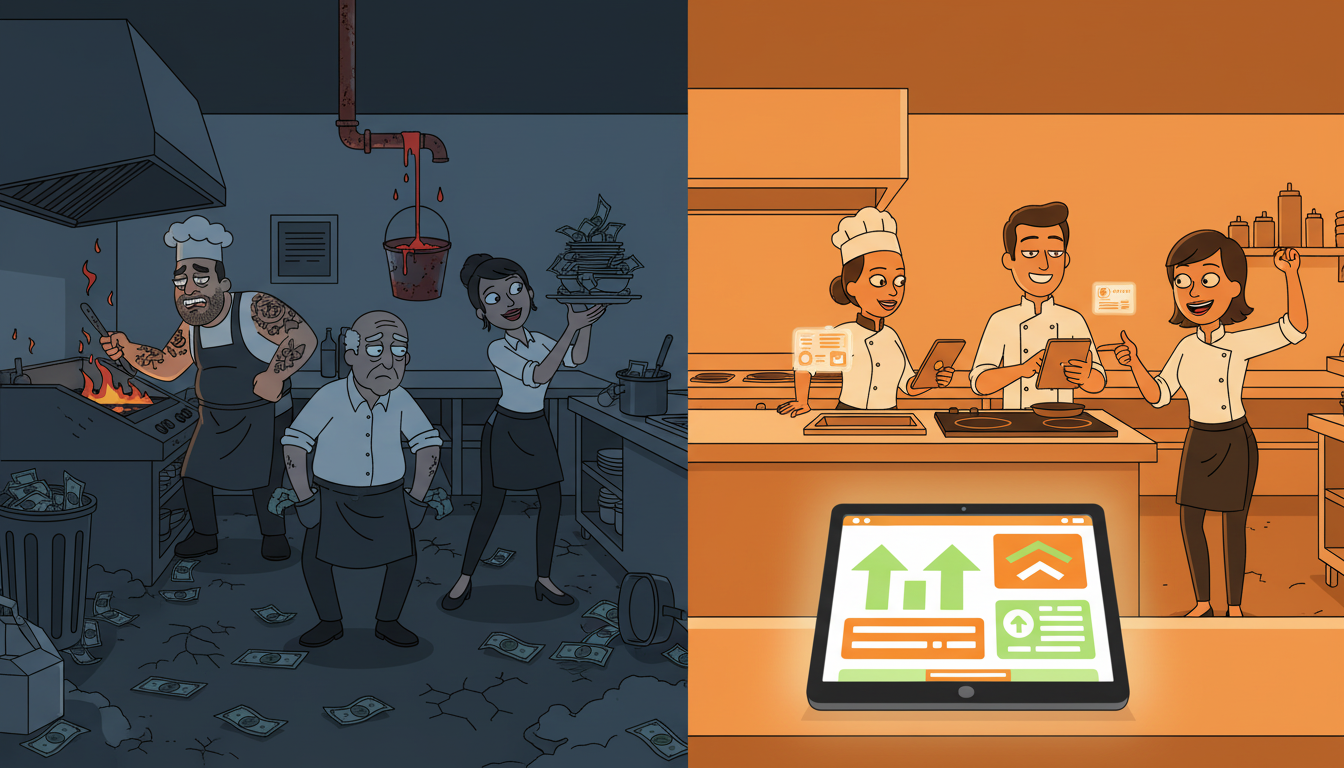
Saleem S. Khatri, CEO of Lavu, put it bluntly in an interview with Restaurant Technology News: "A restaurant doesn't collapse from a single catastrophic event. It bleeds out slowly." Hundreds in labor drift on Tuesday. A void pattern nobody catches on Thursday. An 86'd item running three days and killing $860 in upsells. The bleed is constant, quiet, and expensive. And most AI tools on the market today can't even see it happening, let alone stop it.
What Is the 48-Hour Test for Restaurant AI Tools?
The 48-hour test is a three-part evaluation framework Khatri laid out for every AI product on the market. It's simple, and it's ruthless. If your AI tool can't do all three of these things within two days of being turned on, it's a vitamin — nice to have, not essential. You need a painkiller.
Here's the test:
- Connect to every system you run simultaneously. Not just your POS. Your scheduling, your inventory, your vendor ordering, your labor data — all of it. If it only sees one piece of the puzzle, it's making decisions with incomplete information.
- Surface recoverable dollars within 48 hours. Not "potential savings." Not "efficiency gains." Actual money you can point to. Dollars that were leaking and now aren't.
- Reduce your cognitive load instead of adding another dashboard. If you need to check one more app to get value from this tool, it's not solving the problem. It's adding to it.
Why Most Restaurant AI Tools Fail This Test
The 2026 NRA Show confirmed what operators have been feeling for years. According to RTN's May 13 coverage, "operators are becoming far more capable of distinguishing between legitimate AI and rebranded analytics features wrapped in trendy terminology." Translation: the industry is done being impressed by dashboards with "AI" slapped on the label.
The real problem is fragmentation. A typical mid-size restaurant runs 8 to 15 separate software tools. Your POS sees revenue but misses who made the food and how long it took. Your scheduling system knows labor costs but can't see sales. Your inventory tracker counts what's on the shelf but has no idea what's selling. Each tool works fine in isolation, but none of them talk to each other.
When you add an AI tool on top of that mess, you're not getting intelligence — you're getting a smart layer on top of dumb data. The AI can't connect the dots because the dots aren't connected. It sees your POS data and makes recommendations based on revenue alone, missing the labor context, the inventory context, and the vendor pricing context that would make those recommendations actually useful.
RTN's NRA Show reporting put it well: "Technology vendors can still generate attention with AI buzzwords and automation demos, but operators are becoming far more disciplined buyers." The operators walking the floor this year weren't asking "what does this do?" They were asking "does it replace three of my current tools, or does it become tool number twelve?"
That question is the 48-hour test in action.
What Does the Fragmentation Tax Actually Cost?
Let's walk through a real scenario. It's Tuesday. Your Sysco invoice came in yesterday, but nobody entered the price changes into the inventory system. Your POS is tracking sales at the old food cost. Your prep team is prepping based on last week's par levels, which don't account for the new pricing. By the time someone catches it on Thursday, you've already over-prepped by $400 and under-portioned two high-margin items that killed $860 in upsells.
That's $1,260 in three days. From one disconnected system.
Now multiply that across every system in your stack. Your scheduling tool doesn't know about a local event that's about to double your Friday dinner rush. Your inventory tracker doesn't know your line cook quit and nobody updated the prep assignments. Your vendor ordering system doesn't know you 86'd the salmon three days ago and you're still getting deliveries.
The fragmentation tax isn't a one-time cost. It's a weekly bleed. For a mid-size restaurant doing $15K to $25K a week in food sales, that bleed can run $500 to $2,000 a week in recoverable dollars — money that's leaving your business because your systems can't see each other.
I've been reading through restaurant forums and wiki experience pages from operators dealing with this exact problem. One operator described their kitchen labor costs as "way out of line at ~$25K/week food sales" and said they were "really struggling to keep kitchen labor in check the last year or two." The tools they had didn't connect labor to sales in a way that made the problem visible. They knew it was bad. They couldn't see why.
How Do You Run the 48-Hour Test on Your Current Stack?
You don't need to buy anything to run this test. Grab a notebook or open a spreadsheet. Here's how to do it in one afternoon:
Step 1: List every system that touches food cost. Your POS, your inventory tracker, your vendor ordering platform, your scheduling tool, your prep lists, your recipe costing system. Write them all down. Most restaurants have 8 to 12.
Step 2: Check which ones share data. Draw lines between the systems that actually talk to each other. For most restaurants, the POS connects to the scheduling tool (maybe), and everything else is an island. The gaps in those lines are where your money is leaking.
Step 3: Identify the blind spots. Where are you making decisions without data? Is your prep list based on predicted sales or "what we always make"? Does your ordering system know what you 86'd last week? Can you see labor cost as a percentage of sales in real time, or do you find out when the P&L comes back three weeks later?
Step 4: Quantify the bleed. Pick one gap — the biggest one — and estimate what it costs you weekly. Maybe it's $300 in over-prep. Maybe it's $500 in labor drift. Maybe it's $200 in vendor price changes you didn't catch. Whatever the number, that's your fragmentation tax.
Step 5: Ask your AI vendor the 48-hour question. Turn their three-part test on the tool you're evaluating. Can it connect to all your systems at once? Can it surface recoverable dollars in two days? Will it reduce the number of things you need to check, or add to the list?
If the answer to any of those is no, you're looking at a vitamin. Keep looking.
What Happens When Your AI Actually Passes the Test?
When an AI tool connects all your data sources and starts surfacing recoverable dollars, the changes are immediate and measurable. Operators who consolidate their tech stacks around tools that actually talk to each other report three things within the first month:
First, food cost becomes visible in real time instead of showing up as a surprise on the P&L. You know your food cost is 32% on Tuesday, not three weeks later when the accountant sends the numbers.
Second, labor scheduling gets smarter because the AI can see sales patterns, weather forecasts, and local events — not just "who's available." Scheduling stops being a guess and becomes a forecast.
Third, cognitive load drops because you're checking one integrated view instead of logging into six different dashboards. The fragmentation tax goes from a weekly bleed to zero.
The NRA Show confirmed this trend: operators are consolidating, not expanding. The winners in 2026 won't be the restaurants with the most tools. They'll be the ones with the fewest tools that work together.
Want to See Where Your Restaurant Stands?
If you're wondering whether your current stack is full of vitamins or painkillers, there's a quick way to find out. Take our free AI Readiness Quiz — it takes 2 minutes and shows you exactly where your restaurant has the biggest integration gaps and AI opportunities.
We built it after seeing the same pattern over and over: restaurants with 10+ tools, none of them connected, and an owner who knows something's wrong but can't see where the money is leaking. The quiz maps your current setup and shows you where the 48-hour test would catch problems.
Want us to do the full diagnostic? Our AI SWOT Assessment digs into every layer of your operation and gives you a concrete roadmap for consolidation.
Next step
Find your fastest AI revenue and time wins.
If this article sparked ideas, don't leave them as ideas. Get a Claw Prime AI SWOT assessment and we'll map the highest-leverage opportunities for your business.
Keep reading
Related posts
More practical guidance for owners who want less busywork and better follow-up.
5 Ways AI Is Actually Helping Restaurants Right Now (No Hype)
Forget the hype. Here are five things AI is actually doing in real restaurants right now — from review responses to food cost tracking — with real numbers and zero jargon.

Why 40% of Restaurant AI Tools Get Abandoned in 18 Months
69% of restaurants are adopting AI. But 40% of those tools will be abandoned within 18 months. That's not an adoption problem, it's a selection problem.
Your Phone Is Ringing Off the Hook — Here's How AI Answers It
83% of customers will order from a competitor if their call goes to voicemail more than once. The average restaurant misses 10-20 calls per day during rush - and it is not a staffing problem.