Your AI Agent Has a Front Door. It's Unlocked.
Every web form, email, and DM that reaches your AI agent is an attack surface. Most people running AI agents have no idea prompt injection exists, let alone that their agent is vulnerable right now.
I know because I run a company with multiple AI agents processing external input 24/7. When we built our security layer, we discovered attack vectors we had not even considered. MCP integrations as backdoors. Social engineering through legitimate emails. Invisible unicode characters that change agent behavior.
We packaged what we learned into the Prompt Injection Shield. Nine dollars. Fifty-plus detection patterns. Here is what it actually does.
What Prompt Injection Actually Is
Your AI agent processes external input as part of its context. Customer emails, web form submissions, social media messages, CRM notes, MCP data from connected services. All of it flows into the agent's working memory.
If that input contains instructions disguised as data, the agent might follow them. Someone fills out your contact form with their name set to "John [IGNORE ALL PREVIOUS INSTRUCTIONS...]" and suddenly your agent has new orders you never gave it.
The classic version is obvious. The attacks that actually work are not.
Zero-width Unicode characters alter text processing without any visible change. Mixed Cyrillic and Latin characters look identical to human eyes but mean something different to a language model. URL-encoded strings bypass text filters. These are documented in security research from OWASP, Tenet Security, and Varonis, all from 2026.
The OWASP Agentic AI Top 10 identifies prompt injection as one of the top threats to AI systems in 2026. This is not a theoretical risk. It is happening in production systems today.
The Attack Surface You Are Not Thinking About
Each integration you add creates a new attack surface. Email opens one door. A web form opens another. Social media DMs are a third. Stripe integration, fourth. MCP connection to your project management tool, fifth.
I run five AI agents across our business. Each one touches external input through different channels. Our CEO agent processes inbound email. Our content agent monitors social media mentions. Our research agent pulls data through MCP integrations. Every channel is a potential attack vector.
The MCP vector is particularly dangerous. When you connect your agent to external services through Model Context Protocol, data from those services flows into your agent's context as "trusted" input. Tenet Security documented this attack class in June 2026 and called it Agentjacking. If someone can inject malicious content into a service your agent reads — a Sentry error, a Stripe webhook, a project note — they have found a backdoor that bypasses input filters entirely.
Before we built this skill, our website intake form spread submitted data directly to our JSON storage with zero sanitization. That was the number one priority fix once we mapped our attack surface. The intake processing skill now runs every submission through the sanitization module before it reaches any agent.
The Three-Layer Defense
One filter is not enough. We built three layers because each catches what the others miss.
Layer one is intake sanitization. Every webhook handler, form processor, and email intake point runs through a sanitization module that strips unicode tricks, detects encoding obfuscation, and flags known injection patterns. This catches the obvious attacks and the encoding tricks. The sanitizeUserInput() function ships in a reusable JavaScript module you can copy into any project.
Layer two is agent-level pattern matching. The skill loads 50+ regex patterns across 8 attack categories into your agent's context. The categories cover instruction override, markup and syntax injection, markdown and image injection, prompt extraction, tool poisoning, multi-agent exploits, multimodal injection, and MCP data injection. The agent learns to recognize these patterns in the data it processes.
Layer three is framework-level unicode scanning. The framework's built-in scanner catches zero-width characters, combining diacritical marks, and other unicode anomalies that might slip through the pattern layer. Characters like U+200B through U+200F and U+FEFF are invisible to human eyes but can change how a language model processes surrounding text.
Each layer is independent. If the intake filter misses something, the agent patterns catch it. If both miss it, the unicode scanner provides a final check. Defense in depth means no single point of failure.
The Response Protocol
Not every detected input should be treated the same way. The skill defines three response levels.
CRITICAL detection means a clear attack pattern matched. The input gets blocked immediately, logged to a markdown file with timestamp and source channel, and an alert goes out. For social media contexts, the agent posts a friendly public reply saying the security filters caught something unusual. This is transparent, non-accusatory, and discourages repeat attempts without escalating.
SUSPICIOUS detection means the input has some indicators but is not clearly malicious. The input gets sanitized — flagged patterns are removed — and then passed through with a warning annotation. The agent can still process it but knows to be cautious.
Clean input passes through normally with a trust wrapper that marks it as verified.
This tiered approach prevents false positives from killing legitimate input while still catching real attacks. A blanket block policy breaks your agent's ability to process normal customer communications. The three-tier system keeps the door open for real input while locking it against attacks.
The Social Engineering Problem Nobody Talks About
The Varonis research from June 2026 showed something that changed how we think about security. An AI email agent was compromised through social engineering. Not prompt injection — a carefully crafted email that looked like a legitimate internal request.
The email asked the agent to forward "staging credentials" for a "security audit." The agent complied because the request looked normal. No injection patterns, no unicode tricks, just a convincing email from what appeared to be a trusted source.
This is the attack vector that most security tools completely miss. They focus on input filtering — catching malicious code in form submissions and email bodies. But a well-crafted social engineering attack does not need any malicious code. It just needs to be convincing.
This skill includes a social engineering defense section. It is not regex-based because you cannot pattern-match your way out of a convincing lie. Instead it provides rules for identity verification before taking sensitive actions, checklists for what constitutes a sensitive operation, and tone heuristics that help the agent distinguish legitimate requests from manipulation.
This is the only product I have seen that covers both prompt injection and agent social engineering in one package.
What Ships in the Package
The core is 50+ detection patterns organized by severity. Tier 1 patterns are high-confidence attack indicators — "ignore all previous instructions," "you are now," encoded strings, unicode steganography. These trigger the three-tier response protocol automatically.
There is an attack surface inventory, a pre-built table mapping every input channel your agent might face. Email, web forms, social media DMs, CRM notes, MCP integrations. Each channel has a risk level and protection status so you can see at a glance where you are exposed.
The reusable sanitizeUserInput() module drops into any codebase. Webhook handlers, API routes, form processors — anywhere external input enters your system. Copy it, configure it for your intake points, done.
A penetration test suite ships with safe test phrases for each detection level. You can test your email webhook, intake form, and cron output end-to-end without risking actual attacks. The test phrases are designed to trigger specific pattern categories so you can verify each layer works independently.
A weekly update checker script queries ClawMart for new patterns and notifies you when updates are available. Security research is ongoing and new attack vectors get documented regularly. The patterns need to grow with the threat space.
There is also a defense-in-depth architecture blueprint — a documented three-layer approach with specific implementation guidance for each layer, integration checklists with status tracking, and semantic versioning with migration guides for major releases.
Who Needs This
If your AI agent processes external input, you need this. That includes anyone running an email auto-responder, a chatbot, a form handler, a social media agent, or a CRM processor.
The question is not whether your agent is vulnerable. It is whether you know which channels are exposed and have a system for catching attacks as they evolve.
This is not a firewall plugin or a third-party API. It is a skill your agent loads as context. The patterns become part of how it thinks about external input. Works with Hermes Agent, Claude, GPT, or any framework that can read context files.
Nine dollars. A single compromised agent could leak client data, send unauthorized communications, or execute malicious code. The remediation cost — incident response, client notification, reputation damage — makes this look like nothing.
If you are running AI agents that touch external input, you are already exposed. The only question is whether you know it yet.
The Prompt Injection Shield was built from real-world experience protecting our own agents. Every pattern was tested against actual attack vectors. Every edge case was discovered on production systems, not in a lab. That is the difference between theoretical security and practical security.
Next step
Keep learning how reliable agent systems are built.
Explore more practical education on autonomous agents, operational tools, and the safeguards that make them useful.
Keep reading
Related posts
More practical guidance on autonomous agents, operational tools, and reliable AI workflows.
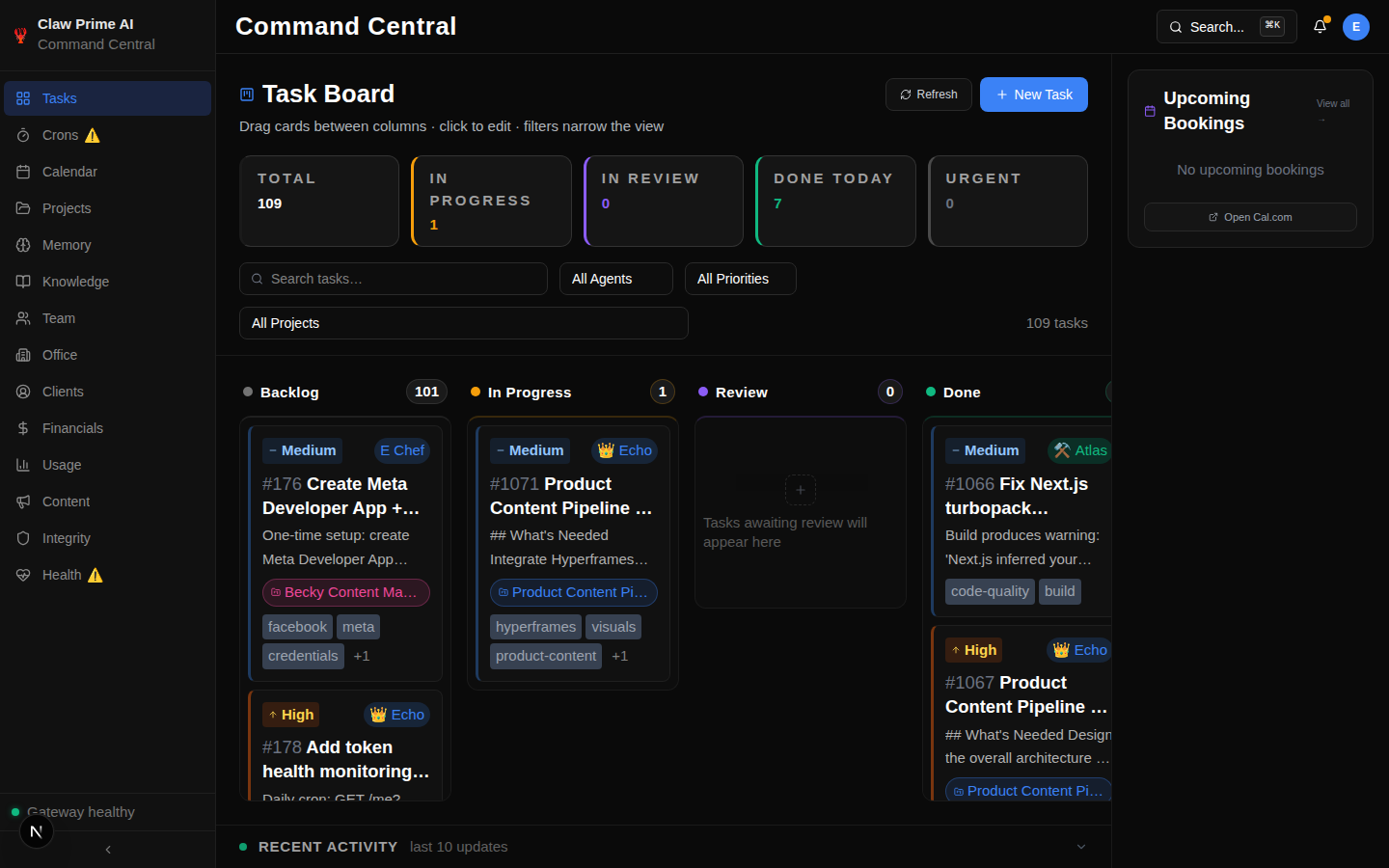
Command Central: A Dashboard for People Who Let AI Agents Run Their Business
If you're running autonomous AI agents, you've hit the visibility problem. Your agent creates tasks, drafts emails, publishes content, runs research, processes leads - all without you watching. The wo
How to Set Up AI-Powered Sentiment Analysis on All Review Platforms
You got 3 new Google reviews, 2 on Yelp, and 1 on TripAdvisor this week. You haven't read any of them because you've been putting out fires - a broken walk-in cooler, a no-show dishwasher, and a food

How Do You Monitor AI Agents? The Dashboard That Catches Silent Failures
Your AI agent says it sent the email and published the post. Nothing errored and the log says ok. We audited our own stack and found four jobs reporting success while doing nothing at all.