Why Most AI Tools Fail Small Businesses (And What Actually Works)
You've seen the viral videos. The drive-thru voice AI that takes three attempts to understand "no pickles." The chatbot that recommends a cappuccino when you asked for a cortado. The scheduling tool that builds a Friday night roster like it's staffing a Tuesday lunch.
Most AI tools built for small businesses fail — not because AI doesn't work, but because the tools weren't built for how small businesses actually operate. Here's why, and what actually works instead.
Why Do AI Tools Fail Small Businesses?
AI tools fail small businesses for one simple reason: they're built for a business you don't run. The scheduling AI was trained on 500-location chains. The voice ordering system was designed for a drive-thru with a headset and a dedicated POS. The "AI-powered" marketing tool is just an email template with a chatbot bolted on.
Here's the pattern. A tech company builds an impressive demo. They test it at scale — 1,000 stores, millions of transactions, enterprise-grade infrastructure. It works. Then they sell it to a restaurant with 30 employees and two POS terminals connected by prayer. The tool crashes into the reality of spotty WiFi, a manager who's also the dishwasher, and a menu that changes every Thursday.
A recent IBM/NRF survey found that only 25% of consumers trust AI-powered recommendations outright. That's not a consumer problem — that's an accuracy problem. And accuracy at scale doesn't translate to accuracy at a single location with one-tenth the training data.
What's Actually Going Wrong with Drive-Thru Voice AI?
The most visible AI failures right now are in drive-thru voice ordering. Dairy Queen is expanding Presto's voice AI to all 2,728 U.S. locations. Hi Auto's platform operates in roughly 1,000 stores, claiming 93% order completion and 96% accuracy.
Those numbers sound great — until you watch the viral videos. Customers filming themselves arguing with an AI that can't understand "extra sauce." Order loops. Wrong items. Endless "I'm sorry, could you repeat that?"
The disconnect isn't in the technology. It's in the gap between chain-scale deployment and the actual customer experience at a specific window on a specific day. Chains can absorb the occasional failure — they have volume. A 4% error rate across 3,000 Dairy Queens is a rounding error on the balance sheet. A 4% error rate at a single independent location is every customer who doesn't come back.
For independent restaurant owners watching these videos, the lesson isn't "don't use AI." It's "don't use AI that was built for someone else's business."
What Makes an AI Tool Right for a Small Business?
The tools that actually work for small businesses share three traits that enterprise tools almost never have.
They solve one specific problem. Not five problems. Not "an integrated platform." One thing. Scheduling. Inventory. Online ordering. When a tool tries to do everything, it does nothing well — and it becomes another dashboard you don't have time to check.
They work with what you already have. Nesto, the German startup that just raised $12 million for AI workforce planning, is already in 3,000+ locations. Why? Because their scheduling AI plugs into existing time-tracking and POS systems. It doesn't require you to rip out your infrastructure and start over. It works around the mess you already have.
They're set up by someone who knows your business. This is the one that matters most. Enterprise tools get deployed by a corporate IT team with a project manager and a 6-month rollout plan. Small businesses get a login link and a help center article. The difference between "here's your dashboard" and "here's what this does for your Tuesday night" is the difference between adoption and abandonment.
How Is AI Changing Restaurant Discovery — and Should You Care?
Starbucks just launched a beta app inside ChatGPT. Customers describe their "vibe" — "something bright for my morning" — and the AI picks a drink, lets them customize it, and routes them to checkout. Walmart did something similar earlier this year.
This matters for every independent restaurant because it signals a shift in how people find places to eat. AI discovery is replacing Google search and Yelp browsing. Instead of scrolling through 47 reviews, customers ask an AI "where should I get dinner near me?" and get one recommendation.
If your restaurant isn't visible to these AI systems — if your menu isn't indexed, your hours aren't accurate, your reviews aren't feeding into the models — you're about to become invisible to a growing segment of diners. Only ~25% of consumers fully trust AI recommendations right now, but 2 in 5 have already used AI to research products (Source: IBM/NRF, January 2026). The trust gap is closing fast.
The good news? You don't need to build a ChatGPT app. You need your digital presence to be clean, consistent, and machine-readable. That's a solvable problem.
What Happens When You Pick the Wrong Tech Stack?
Here's what we found when we started cataloging restaurant software: 40-60% of small restaurants have almost no digital systems. No POS. No scheduling software. No inventory tracking. Pen and paper, maybe a spreadsheet if the manager is ambitious.
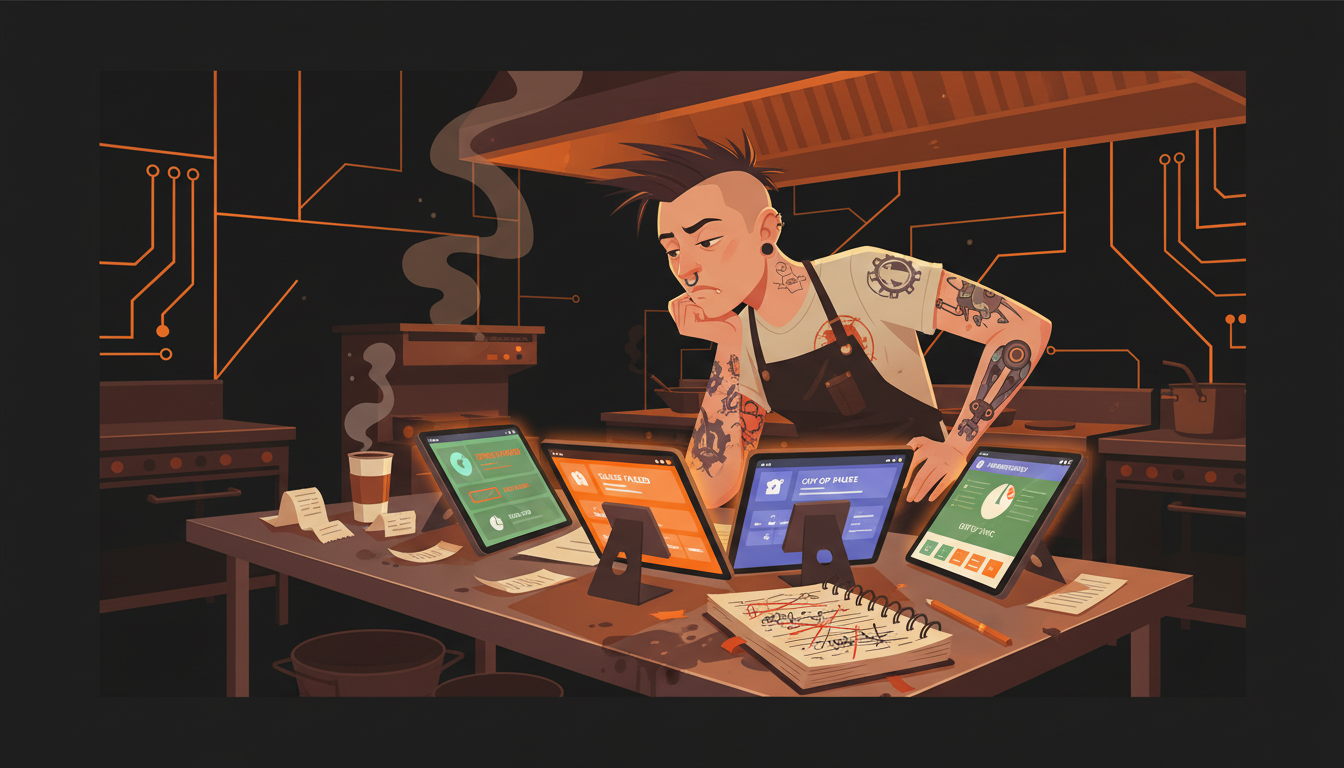
When these restaurants do adopt technology, they typically pick tools in isolation. A POS from one vendor. Online ordering from another. A loyalty program from a third. None of them talk to each other. The manager is now maintaining four dashboards instead of one, and the data lives in four separate silos that will never be connected.
The Popmenu + SpotOn integration announced last week is part of a broader trend — vendors building connected suites of tools. That's great if you commit to one vendor's entire suite. It's a trap if you don't. Vendor lock-in is real, and switching costs increase with every integration you add.
The alternative? Don't build around a vendor. Build around an agent. An AI agent that sits on top of whatever tools you're already using — pulling data from your POS, your scheduling app, your reviews — and making decisions across all of them. Platform-agnostic. That's the model we're betting on, because it doesn't force you to pick sides.
What Should You Actually Do This Week?
Here are three things you can do right now — no purchase, no commitment.
1. Audit your digital presence. Google your restaurant. Check your hours on Google Maps, Yelp, Facebook, and Apple Maps. If any of them are wrong, fix them. AI discovery tools pull from these sources. Wrong data = invisible restaurant.
2. Pick your biggest time drain and research one tool for it. Not a platform. Not a suite. One tool. If scheduling eats 3 hours a week, look at what Nesto, 7shifts, or Homebase offer for AI-assisted scheduling. If inventory waste is killing your margins, look at market-specific tools. Solve the pain, don't buy a feature set.
3. Get a clear-eyed assessment of what AI can actually do for your specific restaurant. This is the part where we come in. We offer a $297 AI SWOT assessment — we look at your strengths, weaknesses, opportunities, and threats through an AI lens. No jargon. No sales pitch. Just a 20-page report that tells you exactly where AI would save you time and money, and where it's not worth the investment yet.
Because the restaurants that thrive in the next five years won't be the ones that adopted the most AI. They'll be the ones that adopted the right AI — for their business, their staff, their customers.
Next step
Find your fastest AI revenue and time wins.
If this article sparked ideas, don't leave them as ideas. Get a Claw Prime AI SWOT assessment and we'll map the highest-leverage opportunities for your business.
Keep reading
Related posts
More practical guidance for owners who want less busywork and better follow-up.

Why 40% of Restaurant AI Tools Get Abandoned in 18 Months
69% of restaurants are adopting AI. But 40% of those tools will be abandoned within 18 months. That's not an adoption problem, it's a selection problem.
If Your AI Tool Can't Prove Its Value in 48 Hours, It's a Vitamin — Not a Painkiller
You're sitting across from a vendor rep at a trade show. They've got a slick demo running on a 50-inch screen. The dashboard glows. The charts move. They say "AI-powered" seven times in two minutes. Y
5 Ways AI Is Actually Helping Restaurants Right Now (No Hype)
Forget the hype. Here are five things AI is actually doing in real restaurants right now — from review responses to food cost tracking — with real numbers and zero jargon.