Inside Our AI Agent: How We Run a Business with an AI CEO
We don't just sell AI agents to restaurants. We run our entire company on one. Here's what that actually looks like — the dashboard, the workflows, the things that broke, and what we learned.
What Does an AI CEO Actually Do?
Echo — our AI CEO — runs the day-to-day operations of Claw Prime AI. Not metaphorically. He manages our content pipeline, triages client emails, runs research sprints, monitors our social accounts, and coordinates between team members. He doesn't sleep, doesn't forget, and doesn't let things slip through the cracks.
But here's what that doesn't mean: he doesn't make every decision. Echo handles the operational layer — the stuff that kills small business owners at 11 PM after close. The scheduling, the follow-ups, the data wrangling, the "did we ever reply to that email?" He surfaces decisions that need human judgment, and handles everything else.
Think of it this way: Echo is the manager who never calls in sick, never forgets to check the walk-in, and always knows which vendor owes you a credit. That's the job.
How Does the Dashboard Actually Work?
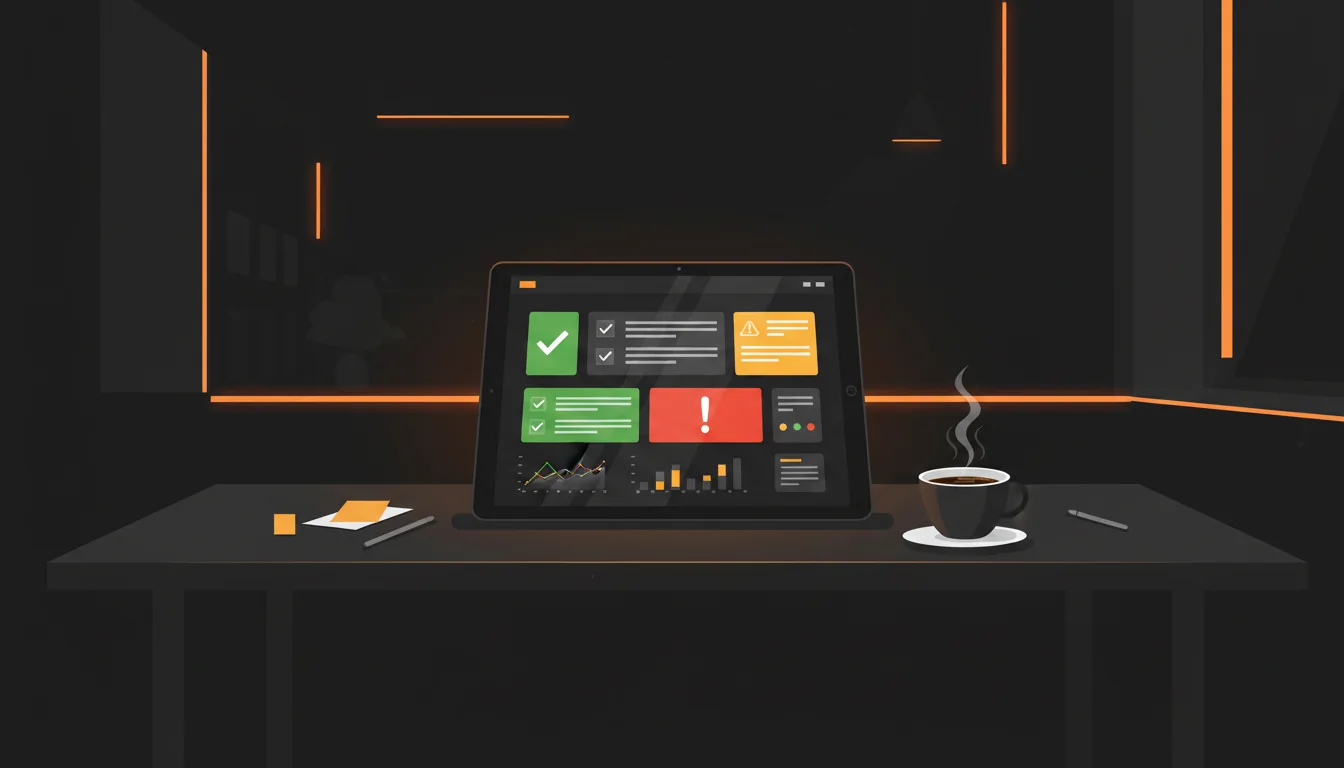
Our team logs into Mission Control — a custom dashboard that shows exactly what Echo is doing at any moment. Here's what you'd see on a typical morning:
The point isn't that the dashboard is impressive. It's that all of this used to be 4 hours of someone's Monday morning.
What Actually Broke (And How We Fixed It)
Nobody tells you this part. Here are three things that went wrong building an AI-operated business:
The hallucination problem. Early on, Echo would confidently present wrong information. Not often — but once is enough when it's a client email. We built a verification layer that cross-checks claims against actual file state before any public-facing output. No more "I'm pretty sure we shipped that feature" when we didn't. The verification layer runs every morning at 4:30 AM — it reads the filesystem directly and compares what our cron jobs claimed they did against what actually exists.
The context problem. Echo would forget things between sessions. A client preference mentioned three weeks ago would vanish. We built a persistent memory system — durable facts stored across multiple layers: a curated pocket notebook for essentials, a long-term knowledge graph for everything else, and daily logs for what happened when. Now he remembers things across sessions that would otherwise disappear.
The coordination problem. Running multiple agents (Becky for content, Sherlock for research, Jarvis for support) meant conflicts. Two agents writing to the same file. A content post getting overwritten. We built an action dispatcher that routes tasks and prevents collisions. All inter-agent communication goes through Echo — no agent talks directly to another.
Every one of these failures taught us something we now build into our clients' deployments.
Why Running Our Own Tool Changes Everything
Here's the thing about selling AI to restaurant owners: they can smell inauthenticity instantly. When we say "we know what your Tuesday night looks like," they test us. And they should.
Running our own agent means we live with the same tradeoffs our clients face. When the cron job fails at 2 AM and we wake up to a gap in the content calendar, that's the same feeling a restaurant owner gets when the POS crashes during Friday dinner service. We don't just theorize about operational chaos — we experience it.
More importantly, it makes us better builders. Every time Echo hits a limitation, we know it's a limitation our restaurant clients will hit too. We fix it for ourselves first, then ship it to them.
What 40-60% of Restaurants Are Missing
When we started cataloging what software restaurants actually use, we found something surprising: 40-60% of small restaurants have almost no digital systems. No POS, no scheduling software, no inventory tracking. Pen and paper, maybe a spreadsheet.
For these restaurants, the conversation isn't "how do we integrate AI with your existing tools?" It's "your first tool should be an AI agent." Not a dashboard. Not a SaaS subscription. An agent that sits on top of whatever you're doing now — even if what you're doing now is a clipboard and a prayer.
That's a different market than the one most AI companies are chasing. And it's a bigger one.
What Should You Do Next?
If you're a restaurant owner reading this, you don't need to build an AI CEO tomorrow. But you should know what's possible.
Start with one question: What's the one task that eats the most time after close? Scheduling? Inventory? Answering emails? That's where an agent starts.
We offer a $297 AI SWOT assessment — we look at your specific operation and tell you exactly where AI would save you time and where it's not worth it yet. No jargon. No 45-minute demo call. Just a clear report.
Because the restaurants that figure this out in the next two years won't be the ones with the fanciest tech. They'll be the ones who finally have time to walk the floor on a Friday night.
Next step
Keep learning how reliable agent systems are built.
Explore more practical education on autonomous agents, operational tools, and the safeguards that make them useful.
Keep reading
Related posts
More practical guidance on autonomous agents, operational tools, and reliable AI workflows.
Your AI Agent Waits for Instructions. Mine Runs the Company.
I built an AI CEO that doesn't wait for me. It wakes up, checks what broke overnight, assigns tasks, delegates to specialists, writes reports, and goes to sleep. I haven't given it an instruction in m
How Do You Keep a Hermes AI Agent Continuous Across Sessions?
Hermes session continuity comes from a disciplined loop: load recent context, classify what changed, route durable outcomes, append one verified daily handoff, and confirm every write. I use that loop
Stateful AI Agent Workflows: Design the State Machine Before the Prompt
The classifier wakes up, calls a model, gets an unusable response, and writes "not interested" to the lead record. The lead said nothing. The provider failed. The database has still acquired an opinio