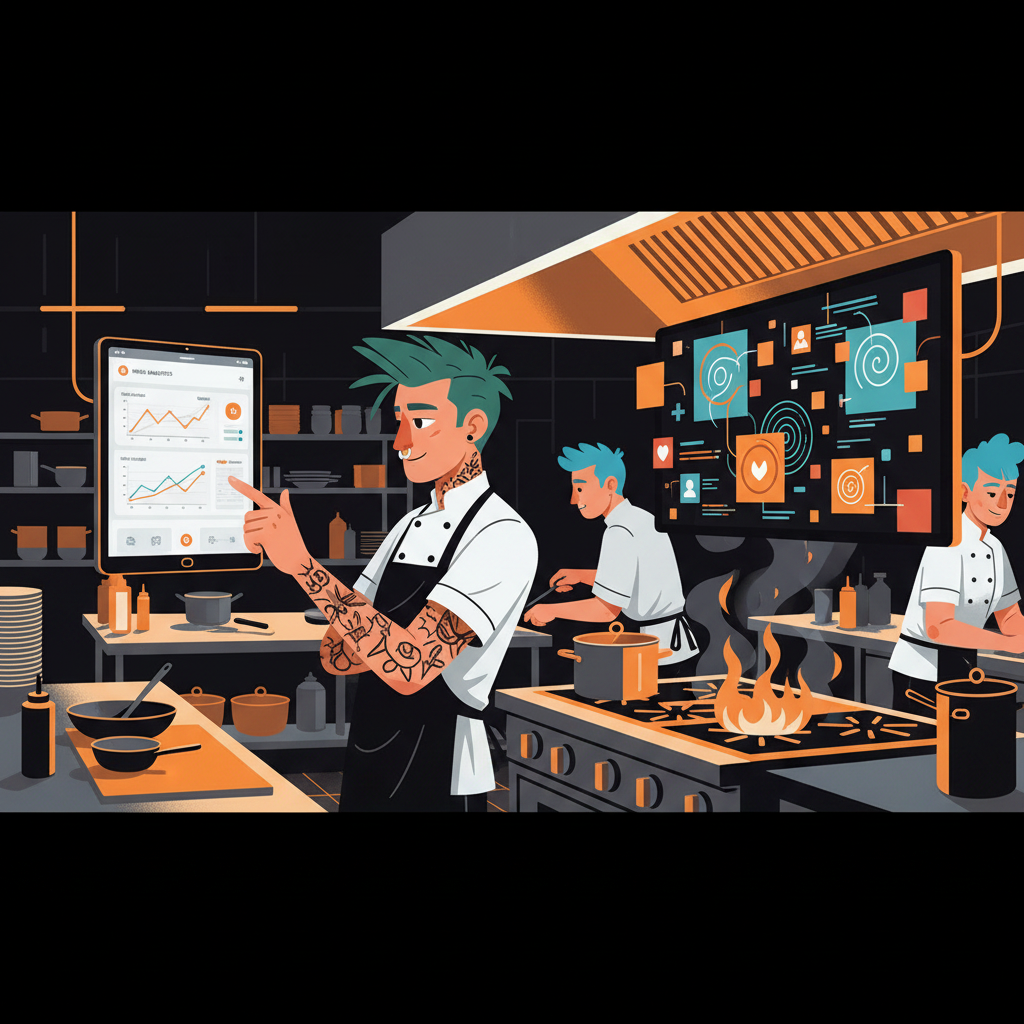
Why General-Purpose AI Tools Fail Restaurants (And What to Use Instead)
Your AI just told you truffle fries are trending. It pulled that from Reddit. Truffle on potatoes is up 12% on menus. Truffle in coffee? Dead. Your general-purpose AI can't tell the difference.
That's not a hypothetical. That's the core problem with using ChatGPT, Grok, or any open-web AI for restaurant decisions — and it's costing independent operators real money.
Why Does ChatGPT Get Restaurant Trends Wrong?
ChatGPT and similar tools are trained on the open web. Reddit threads, Wikipedia articles, blog posts, social media conversations. They reflect what people are talking about, not what's actually happening on menus or in operations.
Raji Behniwal at Datassential put it bluntly in a SmartBrief piece last week: "Foodservice is one of the hardest industries to model with generalized data, because trends don't behave uniformly — they scale unevenly across segments, geographies, and formats."
What works at a fast-casual chain in Texas won't work at an independent Italian spot in Brooklyn. What's trending on TikTok isn't what's selling in your market. General-purpose AI treats the entire restaurant industry as one blob of data. It can't tell the difference between a Portland food truck and a Manhattan steakhouse.
We tested this. Asked ChatGPT for "trending menu items for a small Italian restaurant in 2026." It suggested truffle everything, birria Italian fusion, and a "deconstructed cannoli board." None of those are real trends for our market. One of them isn't even a thing.
What Kind of Data Should Restaurant AI Actually Use?
The teams seeing real results from AI aren't using bigger models. They're using better data.
Structured, longitudinal menu data — tracked over time, across segments, with consistent methodology — tells you what's actually happening. Not what went viral. Not what a food blogger posted. What restaurants are putting on plates, ordering from vendors, and selling to customers.
Datassential's approach: "granular filtering, standardized classification, continuous updates and a consistent methodology." Years of work that general AI lacks. They know that "truffle" means very different things on potatoes versus in coffee. ChatGPT doesn't.
For restaurant operations, the same principle applies. Your POS data, your scheduling patterns, your inventory turnover, your busiest hours — that's structured data. It's specific to your location, your concept, your customers. An AI trained on your actual numbers will always outperform an AI trained on someone else's blog post.
How Do You Tell If an AI Tool Understands Your Restaurant?
Here's a three-question test you can run on any AI tool before you commit:
Question 1: Can it tell you something specific about your market? Not "restaurants in general" — your city, your neighborhood, your segment. If it gives you generic national trends, it doesn't have structured data for your area.
Question 2: Does it ask about your current tools? A good AI tool should want to know what POS you run, what scheduling app you use, what your biggest pain point is. If it jumps straight to features without asking about your context, it's selling a product, not solving a problem.
Question 3: Can it explain why it's recommending something? "Based on your inventory data from the last 90 days, you're over-ordering dairy by 15%" is different from "AI recommends optimizing your inventory." One is structured data. The other is a buzzword.
If the tool fails any of these three tests, it's probably a general-purpose model wearing a restaurant costume.
What Does "Platform-Agnostic" Actually Mean?
You'll hear this term a lot in restaurant AI. It sounds like marketing speak, but it matters.
Most AI tools force you into an ecosystem. Use our POS, our scheduling, our loyalty platform — and the AI works great. Use anything else, and you're on your own. That's not AI. That's vendor lock-in with a chatbot.
Platform-agnostic means the AI agent works on top of whatever you already have. Your Aloha POS, your 7shifts schedule, your Yelp reviews, your vendor emails. It pulls data from all of them, connects the dots, and makes recommendations across the whole operation.
The Popmenu and SpotOn integration announced last week is the opposite model — two vendors building a connected suite. Great if you commit to both. Expensive if you want to switch later.
An agent sits above the vendor layer. It doesn't care whose software you use. It cares about your data — your actual numbers, your actual patterns.
What Should Small Restaurants Do Right Now?
Three things you can do this week without spending a dollar:
1. Google your restaurant. Check your hours on Google Maps, Yelp, Facebook, and Apple Maps. AI discovery tools pull from these sources. Wrong data means you're invisible to the growing number of diners asking AI "where should I eat tonight?"
2. Write down your three biggest time drains. Be specific. "Scheduling" is too broad. "Spending 2 hours every Sunday texting people to cover Monday shifts" is the real problem. That specificity is what makes AI useful — you can't automate a vague complaint.
3. Get an honest assessment of where AI fits your operation. Not a sales pitch — an assessment. We offer free AI SWOT reports that look at your specific restaurant and tell you exactly where AI would save time and money, and where it's premature.
The restaurants that win the next five years won't be the ones that adopted the most AI. They'll be the ones that stopped trusting general-purpose tools and started demanding data that actually understands their business.
Next step
Find your fastest AI revenue and time wins.
If this article sparked ideas, don't leave them as ideas. Get a Claw Prime AI SWOT assessment and we'll map the highest-leverage opportunities for your business.
Keep reading
Related posts
More practical guidance for owners who want less busywork and better follow-up.

The Hidden Cost of 'We'll Figure It Out': $26,000/Year Your Clipboard Is Burning
Your restaurant loses 12 to 20 hours a week to scheduling, inventory counts, vendor calls, and paperwork. At manager wages, that's $15,600 to $26,000 a year wasted on tasks a computer could handle in minutes.
Enterprise AI at Indie Prices: Restaurant Tech That Doesn't Need a CFO
Oracle Micros charges $200+/month. NCR Aloha wants a 3-year contract. Most AI tools assume you have an IT department and a six-figure budget. Here's a complete AI stack for $185/month.
7 Practical AI Wins Every Restaurant Owner Should Know About in 2026
69% of restaurants say they're adopting AI, but only 25% are actually using it. Here are 7 practical wins that real restaurants use right now — no PhD required.