From Zero to AI Agent: A Restaurant Owner's Complete Setup Guide
You've heard about AI agents. Maybe you saw a LinkedIn post from some tech guy saying every restaurant needs one. Maybe your buddy who runs a bar down the street told you his "does his scheduling now." Maybe you Googled "AI agent for restaurant" at 11 PM after a double and landed here.
Good. Stay. This is the guide you actually needed.
We're not going to explain AI to you like you're five. We're not going to pitch you on "the future of dining." We're going to walk you through what an AI agent actually is, what it does for a restaurant, and how to get one running without a tech degree or a $50,000 consulting contract.
Let's go.
What Even Is an AI Agent? 🤖
Forget the buzzwords for a second. An AI agent is software that does work for you. Not a chatbot that answers questions. An agent that takes action.
Here's the difference. You ask ChatGPT, "What's a good way to reduce food waste?" It gives you a list. You ask an AI agent the same thing, and it pulls your POS data, cross-references your inventory against your sales, identifies the items you're over-ordering, and drafts an updated prep list. Then it sends it to your kitchen manager on Slack.
One gives advice. The other does the work.
An AI agent runs on something called a harness, which is just the framework that connects the AI model to your tools. Think of it like the difference between having a brain and having a brain with hands. The harness gives the AI hands to type, click, search, and send messages across platforms you already use.
Still weighing your options? Read our framework comparison guide -- we lay out who each harness is really built for.
The best agent frameworks today can run on your phone, talk to you over text or WhatsApp, connect to your POS system, and schedule tasks to run while you sleep. That's what restaurant AI setup actually looks like in 2026. Not a robot in your kitchen. A digital assistant that handles the grind.
Quick reality check on phone and SMS: answering calls and handling texts sounds amazing, but it needs voice APIs (ElevenLabs, Twilio) and real technical work. It is not something OpenClaw or Hermes does out of the box. Start with text workflows -- the stuff that actually runs unattended -- and add voice later when you have earned your stripes.
Why Restaurant Owners Specifically Need This 💰
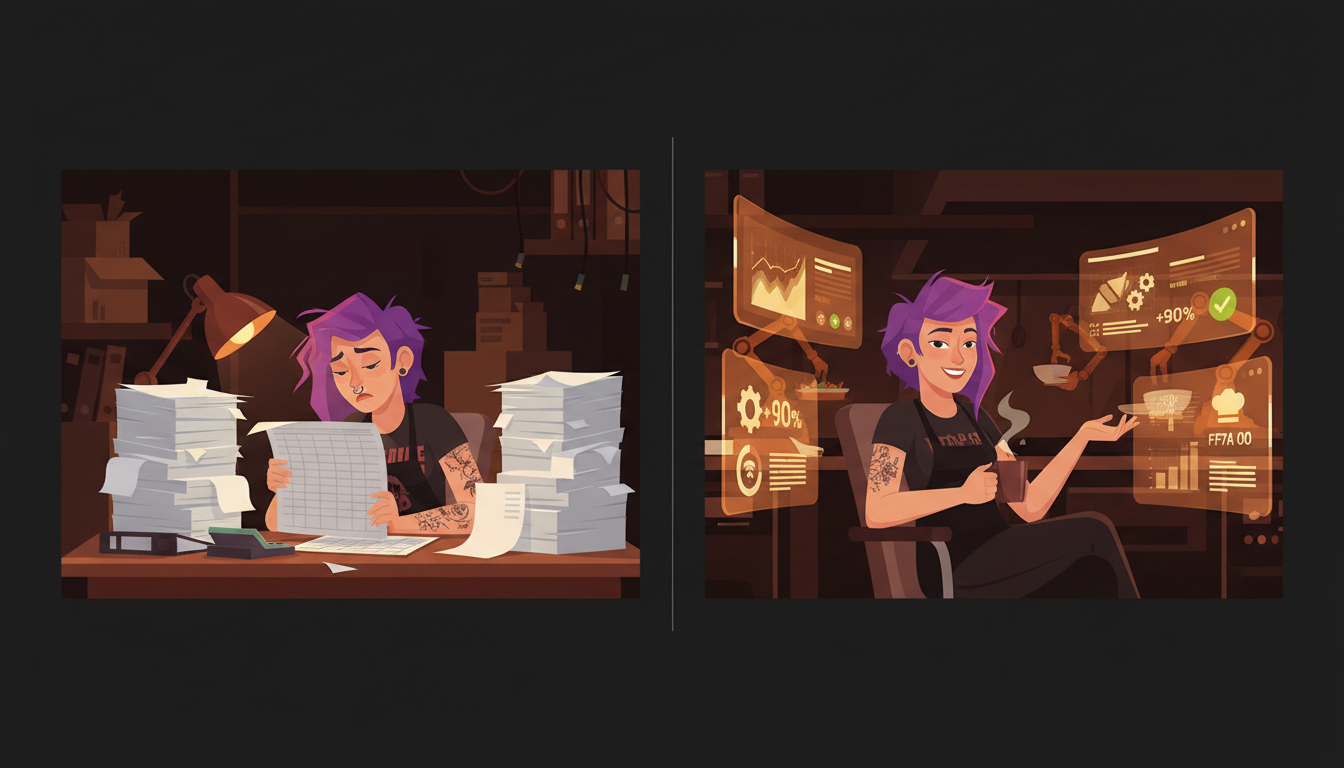
Here's a number that should make you uncomfortable. The average restaurant owner spends 10 or more hours a week on scheduling, inventory tracking, vendor management, paperwork, and replying to reviews. That's not running a restaurant. That's babysitting spreadsheets.
Now multiply that by 52 weeks. That's over 500 hours a year doing admin work that a competent AI agent could handle in the background while you focus on your floor, your team, and your guests.
The chains already know this. They have corporate teams and IT departments figuring out how to automate restaurant operations at scale. The independent owner with two locations and a skeleton crew? They're getting left behind because nobody explained this in plain English.
That's what we're doing right now.
An AI agent for restaurant operations handles the stuff that kills your Tuesday nights. Scheduling conflicts. Vendor calls during service. Inventory counts. The reviews nobody has time to answer. The prep lists that change based on weather and reservations but nobody updates until it's too late.
It doesn't replace your team. It gives your team their time back.
What an AI Agent Actually Does in Your Restaurant 🔧
Let's get specific. Here are the real-world tasks restaurant owners are automating with AI agents right now:
Scheduling. The agent looks at your historical sales data, upcoming reservations, weather forecasts, and staff availability. It builds the schedule. When someone calls out, it finds the replacement and handles the text chain. If your scheduling strategy is texting "who can come in" at 6 AM on a Saturday, we need to talk.
Inventory and food cost tracking. The agent connects to your POS, tracks what's selling, flags slow-moving menu items, and tells you exactly what to order and when. You're paying $36K a week and still losing money on slow menu items nobody's tracking. An agent fixes that.
Vendor management. Price changes, delivery confirmations, invoice reconciliation. The agent monitors your vendor accounts, flags when prices jump, and can even reach out to alternative suppliers.
Review monitoring and response. The agent watches your Google, Yelp, and social profiles. It drafts responses to reviews based on your tone and brand voice. You approve, it posts. No more unanswered 2-star reviews from three weeks ago.
Daily reporting. Every morning, you get a summary. Yesterday's sales, labor cost percentage, food cost percentage, any issues that came up. Not a 40-page dashboard you'll never open. A text message with the five numbers that matter.
Staff communication. The agent can handle routine messages on your team channel. Shift reminders, prep lists, daily specials, allergy alerts. It keeps the information flowing without you being the bottleneck.
This is what it means to automate restaurant operations with AI. Not some futuristic fantasy. Practical, daily tasks that save you hours.
How to Actually Set This Up (No PhD Required) 🛠️
Here's the part most guides skip because they want you to hire them instead. We'll tell you exactly how restaurant AI setup works.
Step 1: Pick your agent platform.
You need an AI agent framework that works for small business. The big names in this space are tools like Hermes Agent, which is open-source and runs on everything from a $5 cloud server to your laptop. It connects to 16 different messaging platforms including WhatsApp, text, Slack, and Telegram. You don't need to be a developer to use it. You need to follow a setup guide and answer some questions.
Other options exist, but for independent restaurant owners, you want something that's affordable, flexible, and doesn't lock you into one AI provider. That's why we recommend platforms that let you swap models and providers without rebuilding everything.
Step 2: Connect your tools.
Your agent needs access to the systems you already use. Your POS, your scheduling app, your email, your messaging platforms. Most modern agent frameworks support this through integrations. You plug in your API keys and the agent can read data and take actions across your tools.
Don't panic. You're not giving the agent the keys to your bank account. You control exactly what it can access and what actions require your approval.
Step 3: Teach it your restaurant.
This is where the magic happens. You feed the agent information about your restaurant. Your menu, your hours, your staff roster, your vendors, your brand voice for review responses, your standards. The best agent frameworks learn from this and get better over time. They build skills based on your specific operation.
A good agent doesn't just follow scripts. It remembers what worked, adjusts its approach, and builds procedures that are specific to your restaurant. That's the difference between a generic chatbot and an actual AI agent for restaurant operations.
Step 4: Set up automations.
Once the agent knows your business, you tell it what to automate. Daily reports at 7 AM. Schedule generation every Wednesday. Inventory alerts when stock drops below par. Review responses within 2 hours of posting. These run on their own. You check in when you want, but the work happens whether you're on the clock or not.
Step 5: Start small and scale.
Don't try to automate everything on day one. Pick the two or three tasks that eat the most of your time right now. Get those running smoothly. Then add more. Most owners start with scheduling and daily reporting because those deliver the fastest time savings.
The whole setup process takes a few hours, not a few months. And once it's running, the agent keeps learning and improving.
What This Costs (Less Than You Think) 💵
Let's talk money because that's what actually matters.
Running an AI agent used to require serious cash. Enterprise software contracts, dedicated hardware, IT staff. That's not the game anymore.
Today's agent frameworks are open-source, meaning the software itself is free. Your costs are the AI model usage, which runs on a pay-per-use basis, and whatever server you run it on. For most restaurant owners, you're looking at $20 to $100 per month in AI model costs depending on how much you automate. A basic cloud server costs $5 to $20 per month.
Compare that to the 10+ hours a week you're spending on admin. Even at $25 per hour, that's $1,000 per month of your time. The agent pays for itself in the first week.
You don't need custom hardware. You don't need a developer on retainer. You need a setup guide, a few hours, and the willingness to let software handle the stuff that's been draining you.
Common Questions from Restaurant Owners ❓
"Will this replace my staff?"
No. It replaces tasks, not people. Your team still runs the floor, cooks the food, and takes care of guests. The agent handles the paperwork and coordination that nobody wants to do anyway.
"What if it screws something up?"
You set approval gates. The agent can draft a schedule, but you approve it before it goes out. It can draft review responses, but you sign off before they're posted. You control the guardrails. It works for you, not instead of you.
"I'm not tech-savvy. Can I actually do this?"
If you can set up a new phone and send a group text, you can set up an AI agent. The platforms have gotten dramatically easier to use. And honestly, the setup process is simpler than configuring your POS system was.
"What about my data and privacy?"
Legitimate concern. Good agent platforms run on your own server or a secure cloud instance. Your data stays yours. You're not feeding your sales numbers into some random startup's database. Look for open-source platforms that give you full control over where your data lives.
Where to Go from Here 🚀
You made it through the guide. Now you have two options.
Option one: close this tab, go back to building schedules in your Notes app, and hope the chains don't figure out AI faster than you do. That's the path most owners will take, and honestly, we get it. You're busy.
Option two: get a clear picture of where AI fits in your specific operation. What to automate first. What the ROI looks like for your restaurant. What the setup actually involves for your setup.
We built a free SWOT assessment for exactly this. It takes 15 minutes. We look at your current operations, identify the biggest time and money drains, and give you a prioritized roadmap for what to automate and in what order. No jargon. No 47-page PDF you'll never read. Just a clear plan built for your restaurant.
Running a restaurant on gut instinct got you this far. Keeping it running on gut instinct is why you're exhausted. Let an AI agent handle the grind so you can get back to the thing that actually matters, being present with your guests and your team.
Your restaurant deserves more than survival mode. Let's build the agent that gets you there.
Next step
Find your fastest AI revenue and time wins.
If this article sparked ideas, don't leave them as ideas. Get a Claw Prime AI SWOT assessment and we'll map the highest-leverage opportunities for your business.
Keep reading
Related posts
More practical guidance for owners who want less busywork and better follow-up.
How to Reduce Food Waste with Predictive AI for Your Restaurant
For every $100 your restaurant spends on food, $4 to $10 ends up in the trash. That's not a guess — it's the industry average. For a mid-size restaurant doing $15K a week in food sales, that's $25,000

How to Automate Staff Scheduling with AI
Your manager spends 4-6 hours a week building schedules that still end up wrong. Here's how AI builds better schedules in 10 minutes using your existing tools and POS data.
How to Migrate from Aloha POS to AI-Enhanced Operations Without Losing Data
Your Aloha POS has 3 years of sales data locked inside proprietary formats. This step-by-step guide shows you how to extract, normalize, and migrate every record without losing a single transaction.