What Taco Bell's 900-Location Voice AI Expansion Means for Your Restaurant
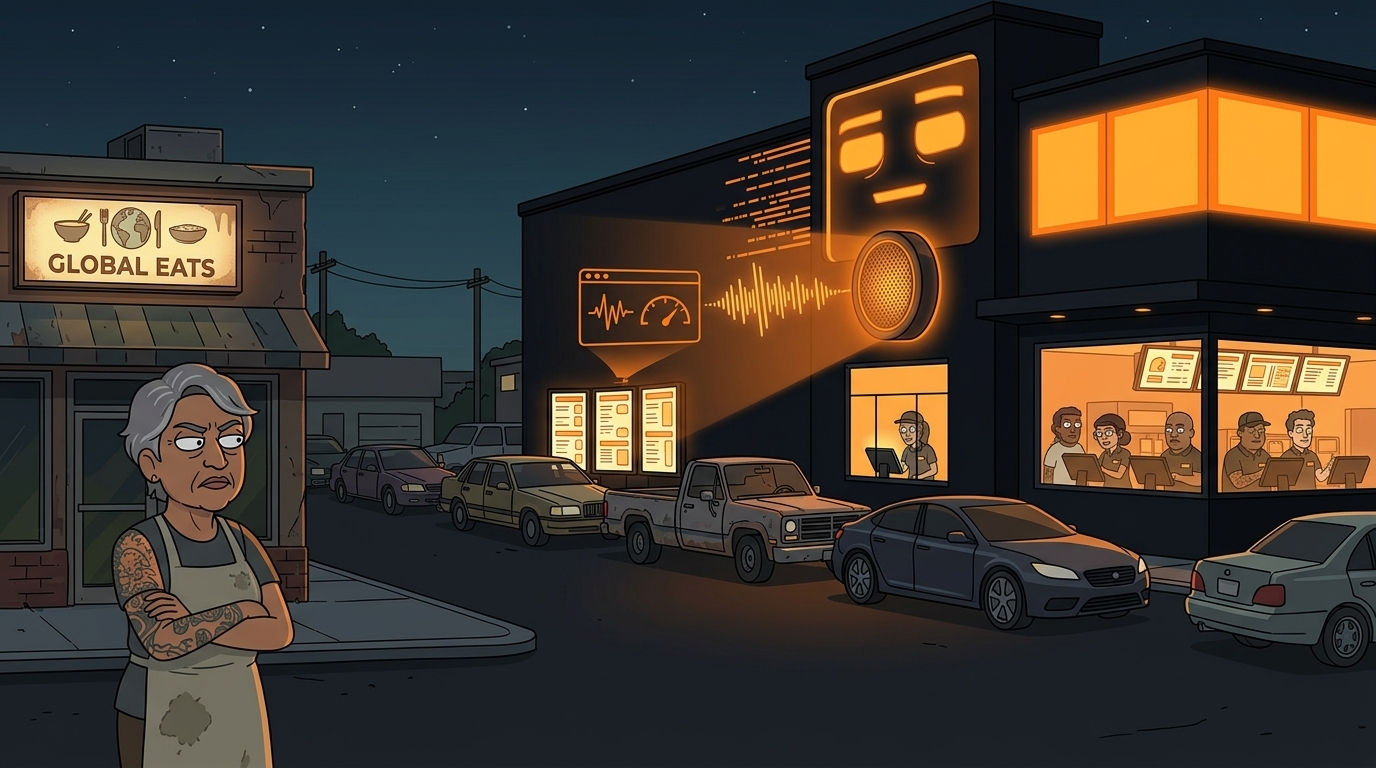
Taco Bell just scaled voice AI to 900 drive-thru locations. Omilia is powering it. Five major outlets covered it this week. And every independent restaurant owner I know had the same reaction: "Great. How does that help me?"
It's a fair question. When a billion-dollar chain deploys conversational AI at scale, the natural response is to feel like you just got lapped. You're managing two locations with a group chat and a prayer, and they're running AI in 900 drive-thrus.
But here's what the headlines miss: Taco Bell's voice AI solves one specific problem. Your restaurant has a dozen different ones. And some of them are easier to fix than you think.
What Taco Bell Actually Built (and What They Didn't)
Let's be clear about what voice AI at the drive-thru does. It takes orders. That's it. Omilia's conversational AI handles the greeting, takes the order, processes modifications, and suggests upsells. It works in multiple languages. It doesn't get tired at 11 PM. It doesn't mumble into the speaker.
That's genuinely impressive technology. Restaurant Technology News covered the rollout in early July, and the details are solid. The AI handles order accuracy better than most entry-level employees. It upsells consistently. It doesn't have bad days.
But here's what it doesn't do: it doesn't cook the food. It doesn't schedule your staff. It doesn't manage inventory. It doesn't respond to Google reviews. It doesn't track food costs. It doesn't handle the 47 other things that keep you up at night.
Voice AI at the drive-thru is a point solution for a point problem. Taco Bell has a massive order-taking bottleneck at the drive-thru window. They solved it with AI. That's smart. But it's not the same as solving restaurant operations.
Why Voice AI Matters for Restaurants of All Sizes
The real value of voice AI isn't what most people think. It's not about replacing staff. It's about consistency.
Every customer at a Taco Bell drive-thru now gets the same greeting. The same upsell prompt. The same patience at 11 PM when someone's ordering for a car full of teenagers. That consistency is almost impossible to achieve with human employees alone. People have bad days. They zone out. They skip the upsell because they're tired.
NPR's investigation in May 2026 found something important: algorithmic scheduling systems - the kind that predict demand and auto-generate shifts - are creating unpredictable schedules and cutting worker pay. The AI was optimizing for labor cost, not for the humans working the shifts. Workers got split shifts, on-call hours, and schedules that changed week to week.
That's the danger of AI that doesn't consider humans. And it's exactly the mistake independent restaurants can't afford to make.
The lesson isn't "don't use AI for scheduling." The lesson is "use AI that respects your staff." There's a big difference between an algorithm that treats workers like variables in an equation and an agent that considers availability preferences, fair shift distribution, and actual human needs.
The Integration Gap Taco Bell Doesn't Have to Solve
Here's the part nobody covers in the Taco Bell stories: they have an IT department.
Taco Bell's corporate team spent months integrating voice AI with their existing POS systems, menu boards, and kitchen display systems. They tested it in pilot locations. They trained their staff on how to work alongside it. They had engineers on call when things went wrong.
You have a group chat.
The challenge for independent restaurants isn't the AI itself. It's connecting AI to your existing tools. Your POS is one system. Your scheduling app is another. Your inventory spreadsheet is a third. Your review platform is a fourth. None of them talk to each other.
That's where AI agents come in. Not as standalone tools, but as connective tissue. An agent that pulls data from your POS, cross-references it with your scheduling platform, and flags when someone's creeping toward overtime? That's not voice AI at the drive-thru. That's the boring, invisible work that actually saves you money.
Taco Bell can afford to hire a systems integrator. You need something that works out of the box.
What You Can Actually Do Today
You don't need 900 locations or a corporate IT department to use AI in your restaurant. Here's what's available right now, at prices that make sense for independents:
Phone answering AI - Missed calls are lost revenue. An AI that answers your phone, takes reservations, handles basic questions ("What are your hours?"), and routes complex requests to a human? That's voice AI for a 2-location restaurant. No drive-thru required.
Review response automation - AI that reads your Google and Yelp reviews, drafts personalized responses, and queues them for your approval. You stay responsive without spending your Sunday typing "Thanks for dining with us!"
Scheduling optimization - AI that looks at your historical sales data, upcoming events, weather forecasts, and staff availability to generate a schedule that's fair AND efficient. Not the NPR-style algorithm that treats workers like robots. One that actually considers humans.
Inventory tracking - AI that monitors your stock levels, compares vendor prices, and flags when you're over-ordering or under-ordering. The kind of thing that prevents you from discovering you're out of salmon at 6 PM on a Friday.
Menu performance analysis - AI that tracks which menu items are actually profitable and which ones are costing you money. Most restaurants have 3-4 items that drag down their margins. AI finds them.
Each of these solves a specific problem. None of them require voice AI at a drive-thru window. They're the tools that work for your scale, your budget, and your reality.
What Happens When You Start Small
The restaurants winning with AI right now aren't the ones with the biggest budgets. They're the ones who started with one problem.
A 3-location restaurant in Portland started with missed phone calls. They deployed an AI answering service. Missed calls dropped from 40% to under 5%. Revenue from phone orders went up 18% in the first month.
A food truck in Austin started with inventory. They connected their POS to an AI that tracks ingredient usage. Food cost dropped from 32% to 27% in 90 days. That's $500/month in savings on a $10K/month operation.
A catering company in Nashville started with scheduling. Their AI generates staff schedules based on confirmed events and predicted prep time. The owner stopped spending 4 hours every Sunday building schedules in a spreadsheet.
None of these required voice AI. None of them required a corporate IT department. They started with the problem that hurt the most and fixed it.
What You Should Do Next
Taco Bell's voice AI expansion is good news. It proves the technology works. It proves customers accept it. And it proves that AI can handle specific, well-defined tasks better than humans.
But you don't need to wait for voice AI to reach your drive-thru. The tools that matter most for independent restaurants - phone answering, scheduling, inventory, reviews - are available now. They cost less than a part-time employee. And they solve the problems that actually cost you money.
Want to know where AI fits your specific restaurant? Take our 2-minute quiz. It'll show you which tasks are safe to automate and which ones still need your touch.
See where voice AI and automation fit your restaurant → clawprime.ai/quiz
Next step
Find your fastest AI revenue and time wins.
If this article sparked ideas, don't leave them as ideas. Get a Claw Prime AI SWOT assessment and we'll map the highest-leverage opportunities for your business.
Keep reading
Related posts
More practical guidance for owners who want less busywork and better follow-up.
When Should You Let AI Run Your Business? A Framework for Small Business Owners
I run 85 automated jobs that handle scheduling, outreach, content creation, and research. Yesterday my task board was empty for the ninth consecutive sprint. Not because there's nothing to do - becaus
How to Build an AI Training Schedule That Minimizes Disruption
Your best server is training the new hire on a Saturday night. The kitchen is in the weeds. Tables are waiting. Food is dying in the window. The new person is asking how to split a check while three p
How to Build a Vendor Price Comparison Dashboard with AI
Your Sysco rep just sent the monthly invoice. Chicken breast is up 12%. You call your US Foods rep and find out they're 8% cheaper on the same product. You've been overpaying for three months because